
36 W 47th St, Booth W07, New York, NY 10036Mon–Fri: 10:00 AM – 6:00 PM
36 W 47th St, Booth W07, Diamond District
Mon–Fri: 10:00 AM – 6:00 PM (Walk-ins Welcome)
Licensed NYC Buyer • Free Precision Appraisal
BROKEN, DAMAGED, SINGLE, TANGLED, OR UNWANTED GOLD

Sell Scrap Gold in NYC

Broken, mismatched, outdated, or unwearable gold may still have significant value because the gold content matters more than appearance when an item is genuinely scrap. Buyers of NYC evaluates scrap gold at its Manhattan Diamond District office, explains the weight and purity assessment, and provides a clear, no-obligation purchase offer.

Before treating anything as scrap, our specialists check whether the piece may be worth more because of its brand, age, craftsmanship, gemstones, coin value, bullion form, or secondary resale demand. Bring your items as they are—do not remove stones or break them apart first.
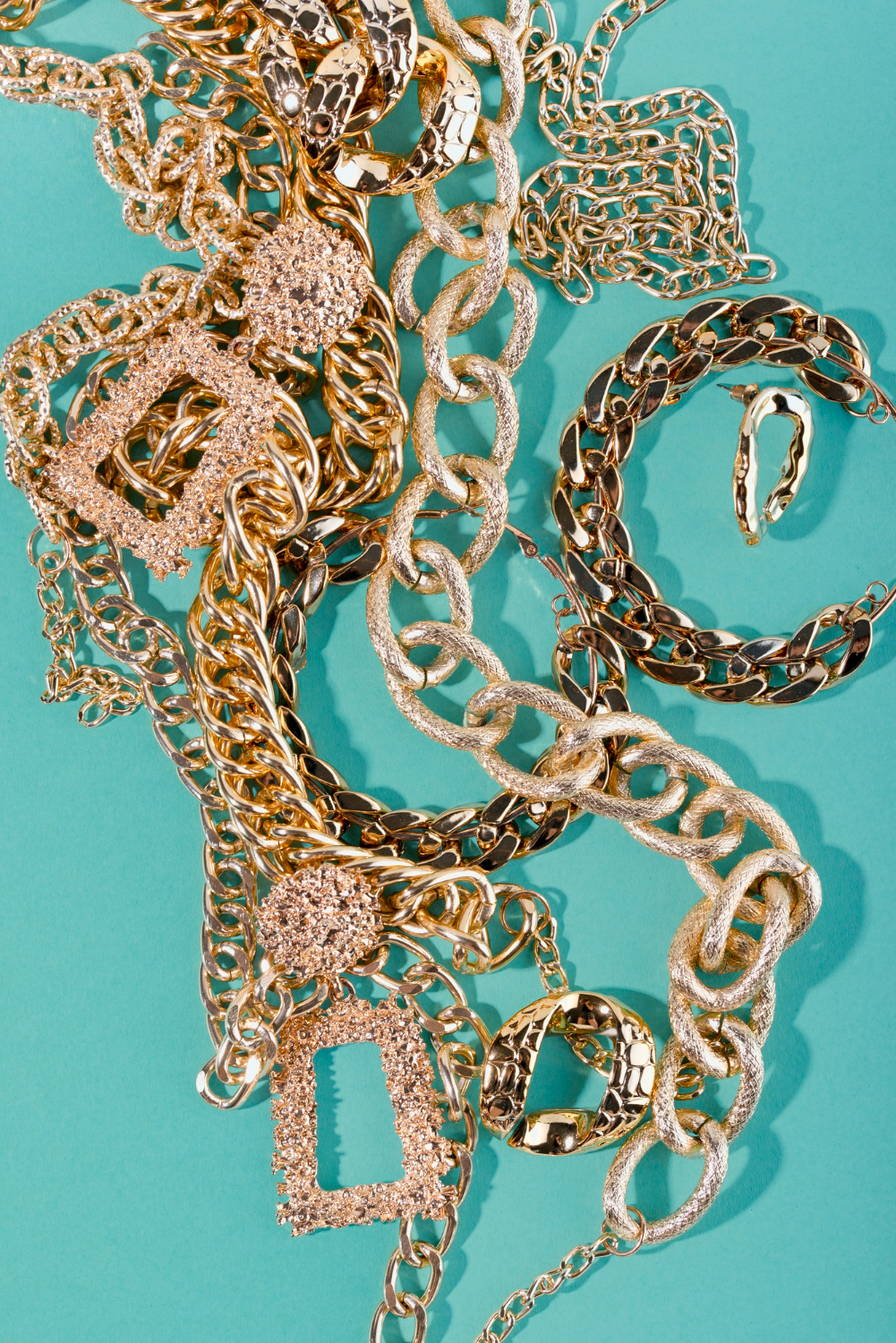

Sell Scrap Gold in NYC - Broken & Unwanted Gold Appraisal
LICENSED & CERTIFIED IN NEW YORK CITY

Recognized Credentials, Industry Licenses & Certified Gemologists

FREE & CONFIDENTIAL EVALUATION

Why Sellers Choose Buyers of NYC for Scrap Gold Purchases

GIA-Trained Gemologists

Every ring is reviewed in-person by certified gemologists using professional diamond grading microscopes, colorimeters, and high-precision electronic balances.

Complete-Piece Evaluation

We assess the principal center stone, side diamonds, fine platinum/gold settings, and designer signatures together rather than treating the piece merely as scrap metal.

Private & Respectful

Evaluations are conducted in a secure, discrete Midtown office. We never inquire about emotional circumstances, divorce, or reasons for selling.

Immediate Settlement

Receive a transparent, no-obligation purchase offer with immediate payment via same-day wire transfer, company check, or cash upon acceptance.

Definition & Scope

What Types of Scrap Gold Does Buyers of NYC Purchase?

Scrap gold is gold whose primary market value is expected to come from recoverable precious-metal content rather than resale as an intact finished item. ‘Scrap’ describes the likely valuation path—not whether the item is clean, attractive, old, or wearable:
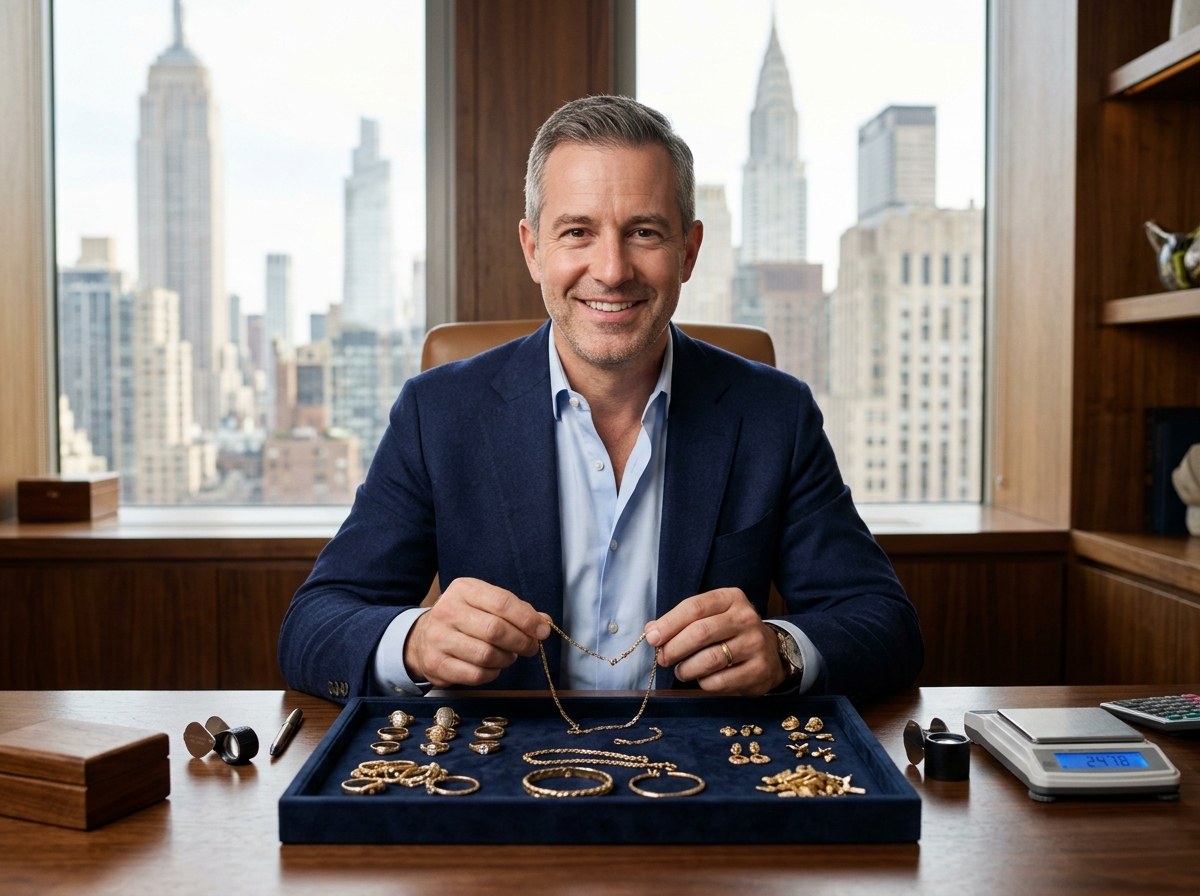
What Types of Scrap Gold Does Buyers of NYC Purchase?
MANHATTAN ASSAY CENTER

Scrap Gold Forms & Valuation Scope

01

Broken Karat Gold Jewelry

Damaged Jewelry
Representative items

Snapped 10K/14K/18K chains, broken bracelets, bent rings, damaged clasps, and cracked mountings.

Important review questions

Tested karat fineness, gold-bearing gross weight minus non-gold findings, and pre-screening for resale value.

Request an Evaluation
02

Single Earrings & Partial Sets

Mismatched Items
Representative items

Single stud or hoop earrings, unmatched cufflinks, loose pendant charms, and individual links.

Important review questions

Evaluated collectively in a single lot; backs, posts, and fragments are included in payable weight.

Request an Evaluation
03

Tangled Chains & Mixed Lots

Estate Lots
Representative items

Knotted chain clusters, outdated inherited gold jewelry, heavily worn items, and mixed-karat lots.

Important review questions

Individual sorting by karat mark and alloy group before precision legal-for-trade digital weighing.

Request an Evaluation
04

Gold Fragments & Findings

Findings & Parts
Representative items

Loose clasps, setting heads, pin stems, earring posts, jump rings, trimmings, and bench scrap.

Important review questions

Tested composition to ensure material is solid karat gold rather than base metal repair solder.

Request an Evaluation
05

Dental Gold & Crowns

Dental Alloy
Representative items

Gold-bearing dental crowns, bridgework, inlays, and caps brought in safe sealed containers.

Important review questions

Evaluated subject to safe handling, non-destructive composition testing, and precious metal assay.

Request an Evaluation
06

Coins, Bars & Watch Parts

Pre-Screening
Representative items

Damaged collectible coins, recognized bullion ingots, antique pieces, and gold watch cases.

Important review questions

Screened for numismatic, brand, or finished resale value before any metal-only scrap determination.

Request an Evaluation
Pre-Screening Protocol

What Should Be Checked Before an Item Is Treated as Scrap?

Do not assume that old, broken, or unfashionable means “melt only.” Signed designer jewelry, antique construction, valuable gemstones, luxury watch components, collectible coins, recognized bullion, unusual craftsmanship, and intact matching sets can change the best valuation path:

01
Brand & Maker

Signed Designer Hallmarks

Maker stamps from heritage houses (e.g. Cartier, Tiffany & Co., Van Cleef & Arpels, Bulgari, David Webb) carry brand prestige and secondary collector demand that command premiums above raw metal melt.

02
Gemstone Value

Diamonds & Precious Gemstones

Natural diamonds, rubies, sapphires, or emeralds mounted in damaged gold settings warrant separate gemological appraisal rather than being discounted or deducted during testing.

03
Antique & Period

Antique & Period Craftsmanship

Victorian, Edwardian, Art Deco, or retro pieces with hand-engraving, filigree work, or historical provenance often possess estate value that exceeds gold content alone.

04
Bullion & Coin

Collectible Coins & Bullion

Gold coins (Eagles, Krugerrands, Sovereigns) and stamped mint bars should be verified for strike, date, mint mark, and bullion trading premiums before being treated as scrap.

05
Horology & Ref

Luxury Watch Gold Components

Gold watch cases, bezels, dials, and bracelet links from Swiss luxury brands (Rolex, Patek Philippe, Audemars Piguet) carry significant spare-part and collector value.

06
Set Integrity

Intact Matching Sets & Suites

Matching earring pairs, suite necklaces, and complete heirloom sets may command a premium as intact wearable jewelry rather than individual broken components.

Estate & Collection Pre-Screening Protocol: Buyers of NYC first looks for these indicators, then determines whether the item should be priced for resale, collectible demand, precious-metal recovery, or a combination of factors. This review is especially important for inherited jewelry and mixed estate collections where the seller may not know what each piece is.

Valuation Methodology

How Is Scrap Gold Value Calculated?

Evaluating fine jewelry requires examining interdependent value drivers rather than applying an arbitrary single number.
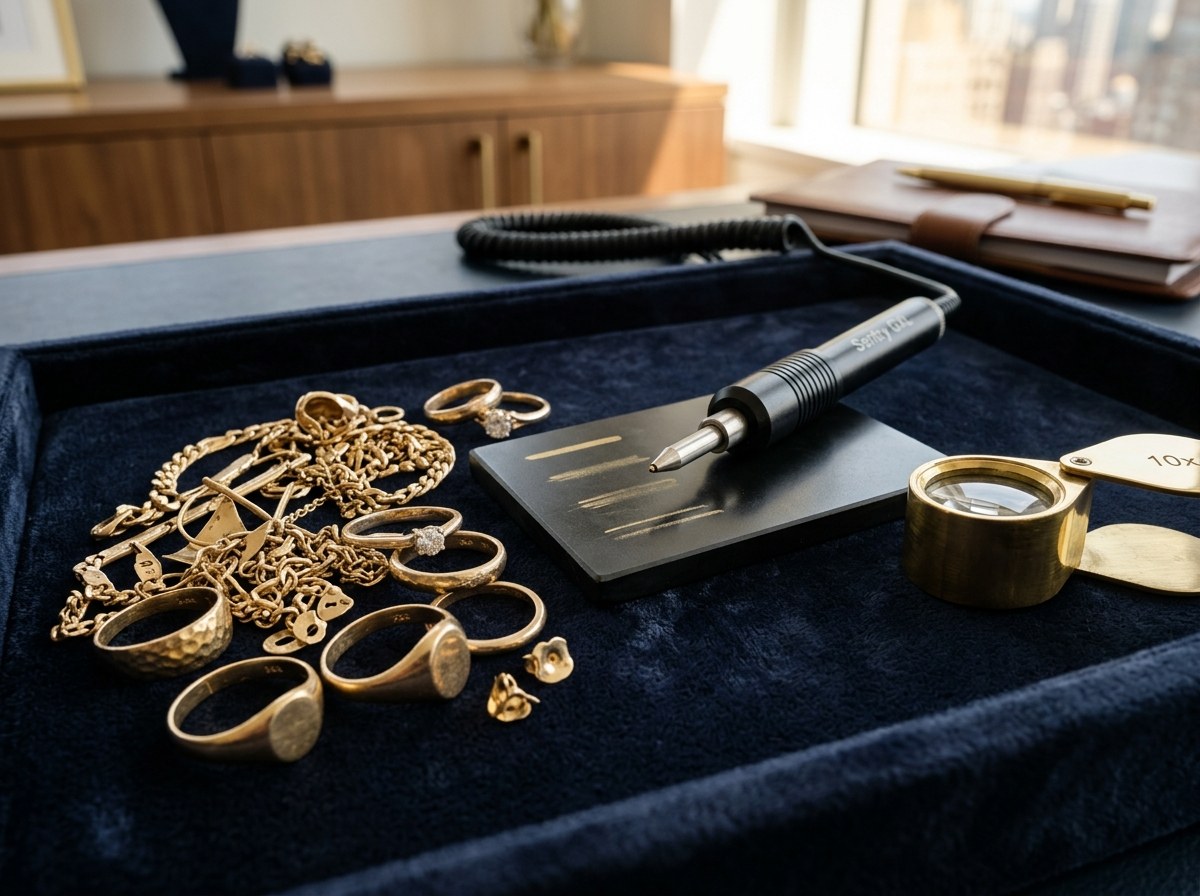
Testing karat fineness and electronic assay

1. Identify Tested Fineness

Purity Science

Hallmarks (10K, 14K, 18K, 750) provide initial clues, but non-destructive electronic assay and touchstone testing confirm actual pure gold percentage.

Karat Benchmark: 10K (.417), 14K (.585), 18K (.750), 22K (.916), 24K (.999 fine gold).

2. Determine Gold-Bearing Weight

Certified Scales

Items are weighed on state-calibrated legal-for-trade digital scales in grams, pennyweights (dwt), or troy ounces (1 troy oz = 31.1035g = 20 dwt).
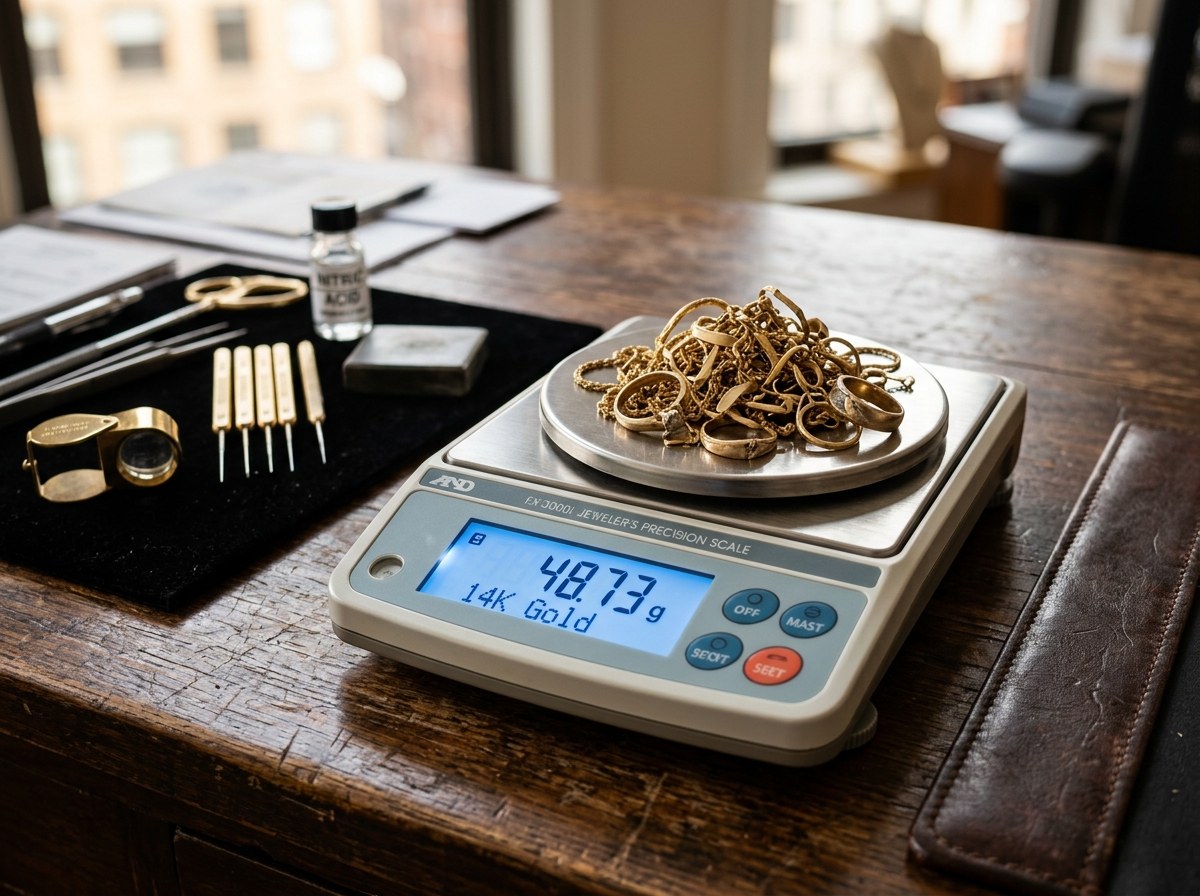
Weight Integrity: Non-gold stones, steel springs, and lead solder are accounted for in net payable weight.
Fine gold calculation and market valuation

3. Calculate Pure Gold Content

Fine Weight Formula

Gross gold-bearing weight multiplied by the verified fineness ratio gives the estimated fine-gold weight (e.g. 10g of 14K yields ~5.83g of pure fine gold).

Mathematical Formula: Gross Weight × Purity Decimal = Net Fine Gold Weight.

4. Apply Market Context & Resale Value

Purchase Offer

The live gold market price provides baseline context. Final offers reflect payable weight, refining costs, and any added brand or gemstone value beyond melt.

Value Beyond Scrap: Signed jewelry and valuable diamonds receive separate evaluation above metal scrap value.
Payout Calculation Pipeline
MATHEMATICAL FORMULA

How Is Scrap Gold Value Calculated?

A scrap gold purchase offer reflects verified precious metal composition, legal-for-trade weight, live market spot rates, and any secondary value:


Gross Scrap Weight Verified Grams / DWT Calibrated Digital Scales
+
Tested Karat Purity 10K / 14K / 18K / 24K Electronic Assay & Touchstone
+
Market Reference Rate Current Gold Spot Context Live NY/London Spot Market
=
Total Purchase Offer Net Payout Settlement Immediate Wire / Check / Cash
Component Itemization Note: Every scrap gold lot is weighed and tested in your presence. We explain the exact mathematical calculation so you have complete clarity before deciding to sell.

Bring Uncertain Pieces for In-Person Assay

Bring all unmarked, worn, or uncertain jewelry directly to our Manhattan Diamond District office. Our assay team will safely test each piece under magnification without cost or obligation.

Testing Methodology: Non-destructive electronic assay, X-ray fluorescence, and touchstone verification determine exact composition without harming jewelry surfaces.

Avoid Destructive Home Tests

Do not file into jewelry, use harsh acid test kits, or rely solely on magnets. Some home testing methods permanently damage resale value or create hazardous chemical exposure.

Seller Warning: Acid kits create dangerous fumes and ruin gold luster; magnets alone cannot confirm gold purity due to non-magnetic brass and lead alloys.
Material Classification

Is Gold-Plated, Gold-Filled, or Vermeil the Same as Solid Gold?

No. These terms describe distinctly different constructions and very different amounts of precious metal. The hallmark and underlying substrate determine actual recoverable value:

Bonded Layer 5%–10% Gold Layer
Marks: 1/20 12K GF, 1/20 14K GF, 1/10 10K, RGP

Gold-Filled (GF / RGP)

A measurable sheet of karat gold mechanically bonded under intense heat and pressure to a brass or copper base-metal core (typically 5% or 10% of total item weight).

Valuation Pathway: Contains far more gold than plating; evaluated by gross weight, bonded layer karat percentage, or secondary vintage brand appeal.
Electroplate Flash < 0.05% Gold Surface
Marks: GP, HGE, Electroplate, EP, GE

Gold-Plated (GP / HGE)

A microscopic surface flash of gold deposited electrically over a base metal (brass, copper, or steel). The gold layer is only fractions of a micron thick.

Valuation Pathway: Minimal recoverable metal; evaluated primarily if the piece is signed by a collectible designer, contains genuine stones, or has antique appeal.
Silver Base .925 Sterling Substrate
Marks: 925, Sterling, Vermeil, 925 Plated

Vermeil (Gold on Silver)

A heavy gold plating (at least 2.5 microns) over a solid sterling silver (.925) core. High precious-metal content driven by the solid silver substrate.

Valuation Pathway: Valued primarily on verified sterling silver weight, plus secondary brand equity (e.g. vintage Cartier, Tiffany) and mounted gemstones.
Channel Comparison

What Are the Main Ways to Sell Scrap Gold in NYC?

Ensure maximum financial return, immediate settlement speed, and counterparty security when liquidating fine jewelry:

Local Neighborhood Retail Jewelers & Pawnshops

Neighborhood Retail
Local Convenience

Nearby physical storefront for walk-in visits.

Lower Melt Payouts & Overhead Markdowns

High retail overhead often means lower purchase offers; smaller shops may lack specialized electronic testing equipment for precise purity verification.

Online Mail-In Gold Buyers

Mail-In Services
Remote Shipping

Prepaid mail-in shipping kits without leaving home.

Shipping Risks & High Hidden Deductions

Items leave your possession; return shipping fees or restocking clauses if you reject low initial mail-in purchase offers.

Peer-to-Peer Marketplaces (Online Classifieds)

High Risk Route
Theoretical Direct Sale

Direct consumer-to-consumer listing.

Safety Hazards & Payment Disputes

Meeting strangers with valuable gold pieces, chargeback fraud on electronic transfers, counterfeit claims, and zero professional weight verification.

Step-by-Step Guidance

What Happens During an In-Person Scrap Gold Evaluation?

Our evaluation protocol is conducted in-person at our Manhattan Diamond District office with complete transparency and zero obligation to sell.

Step 01

Sort & Inspect

Items are grouped by visible hallmarks, karat purity, and construction. Signed jewelry and valuable gemstones are screened for resale value.

Step 02

Precision Testing

Non-destructive electronic assay and touchstone testing confirm the karat fineness of each piece and verify that unmarked items contain gold.

Step 03

Certified Weighing

Items are weighed in front of you on state-calibrated legal-for-trade digital scales, stating the exact weight in grams, pennyweights, or troy ounces.

Step 04

Clear Offer & Payment

We explain the pure gold calculation and market factors, then present a no-obligation purchase offer with immediate payment via wire, check, or cash.

Preparation Guide

How to Prepare Scrap Gold Before Visiting

Follow these practical preparation tips to maximize payable weight and protect item value:

Bring Every Small Piece

Single earrings, broken clasps, loose links, posts, charms, and fragments all add to total gold-bearing weight.

Do Not Cut or Melt Items

Keep pieces intact. An item may have maker hallmarks, antique provenance, or collector equity not obvious to the owner.

Do Not Remove Gemstones

Leave diamonds and stones intact in their settings so our gemologists can determine if they warrant a separate valuation.

Avoid Harsh Home Chemicals

Do not file into jewelry or use harsh acid test kits. Leave non-destructive professional testing to our certified assayers.

Transparency Framework

How to Compare Scrap Gold Offers

Ask every precious metal buyer these essential questions before accepting an offer:

Q1

Verified Weight Unit Stated

Ensure the buyer clearly states whether weight is measured in grams, pennyweights (dwt), or troy ounces.

Q2

Tested Karat Purity Disclosed

Confirm the tested purity used for each piece (e.g. 10K, 14K, 18K) rather than an arbitrary blended average.

Q3

Itemized Component Breakdown

Check that non-gold components and valuable gemstones are separated transparently rather than deducted arbitrarily.

Q4

Net Payout with Zero Hidden Fees

Compare the final bottom-line cash or wire settlement with no surprise refining fees or processing deductions.

Our Team

Connect with Our Evaluation Experts

Visit our Manhattan Diamond District office to meet with our GIA-trained gemologists and experienced jewelry specialists for a private, no-obligation evaluation.

Savannah Nguyen

Head of Precious Metals

Cody Fisher

Head of Fine Jewelry

Leslie Alexander

Head of Watches

Jacob M.

Head of Diamonds & Precious Stones

FAQ

Frequently Asked Questions About Scrap Gold

Does broken gold lose all of its value?

No. If a piece is genuine karat gold, broken condition usually does not remove its precious-metal content. Condition matters more when an item may be resold intact or has brand, antique, gemstone, coin, bullion, or watch value.

Do you buy single earrings, tangled chains, and small pieces?

Yes. Single, mismatched, tangled, and small gold pieces can be evaluated together. Bring the entire lot, including backs, clasps, links, and fragments.

Can you evaluate gold without a stamp?

Yes. Unmarked items can be inspected and tested. A stamp is helpful, but it is not the only way to determine whether an item contains gold.

Do you buy gold-filled or gold-plated items?

They can be reviewed, but they are not valued like solid karat gold. Gold-filled material contains a bonded layer of gold over base metal, while plating is much thinner and may have little recoverable gold value. Brand, silver content, stones, or design can still matter.

Do you buy dental gold?

Gold-bearing dental material may be considered subject to safe handling, inspection, testing, and composition. Bring it in a sealed container and do not use chemicals or destructive cleaning methods.

Should I remove stones before selling scrap gold?

No. Leave stones and settings intact. A buyer should determine whether the stones or complete piece have separate value before any metal-only decision.

How will the weight be stated?

Gold may be weighed in grams, pennyweights, or troy ounces. The unit should be identified clearly, and New York City rules require businesses buying used precious metals to inform the seller of the troy weight.

Is the scrap-gold evaluation a formal appraisal?

No. It is a purchase evaluation used to prepare an offer. A formal written appraisal for insurance, tax, estate, probate, divorce, or legal use is a different service.

Am I obligated to accept the offer?

No. You can review the explanation, ask questions, and decide whether to sell.

Start Your Evaluation

Visit Buyers of NYC in Manhattan’s Diamond District

Buyers of NYC is located at 36 W 47th Street, Booth W07, New York, NY 10036, in Manhattan’s Diamond District. Current published hours are Monday – Friday: 10:00 AM – 6:00 PM. Appointments are preferred and walk-ins are welcome during published hours.

Manhattan Office

36 W 47th Street, Booth W07
New York, NY 10036
(Between 5th & 6th Avenues)

Hours of Operation

Monday – Friday: 10:00 AM – 6:00 PM
Appointments preferred; walk-ins welcome

Direct Phone & Email

Phone: 646-400-4553
Email: buyersofnyc1@gmail.com

For high-value fine jewelry, signed designer pieces, or estate collections, calling 646-400-4553 in advance ensures dedicated evaluation time with our GIA-trained diamond specialists.

Request a Scrap Gold Evaluation

Describe your item, stone count, precious metal, and any documentation.

Privacy & Safety Notice: Do not upload government identification, divorce papers, wills, trusts, court orders, or sensitive financial records. Online submissions are preliminary and do not create a purchase offer, authentication, or obligation to sell.

Reviewed by Buyers of NYC Diamond Evaluation Team Last reviewed August 2026 | Manhattan Diamond District